Kilometers to Inches Converter: Convert km to Inches Precisely
Convert kilometers to inches instantly using the exact NIST-defined factor: 1 km = 39,370.0787 inches
Try the calculator
Math runs in your browser. No sign-up.
Exact factor: 1 km = 39,370.0787401575 in
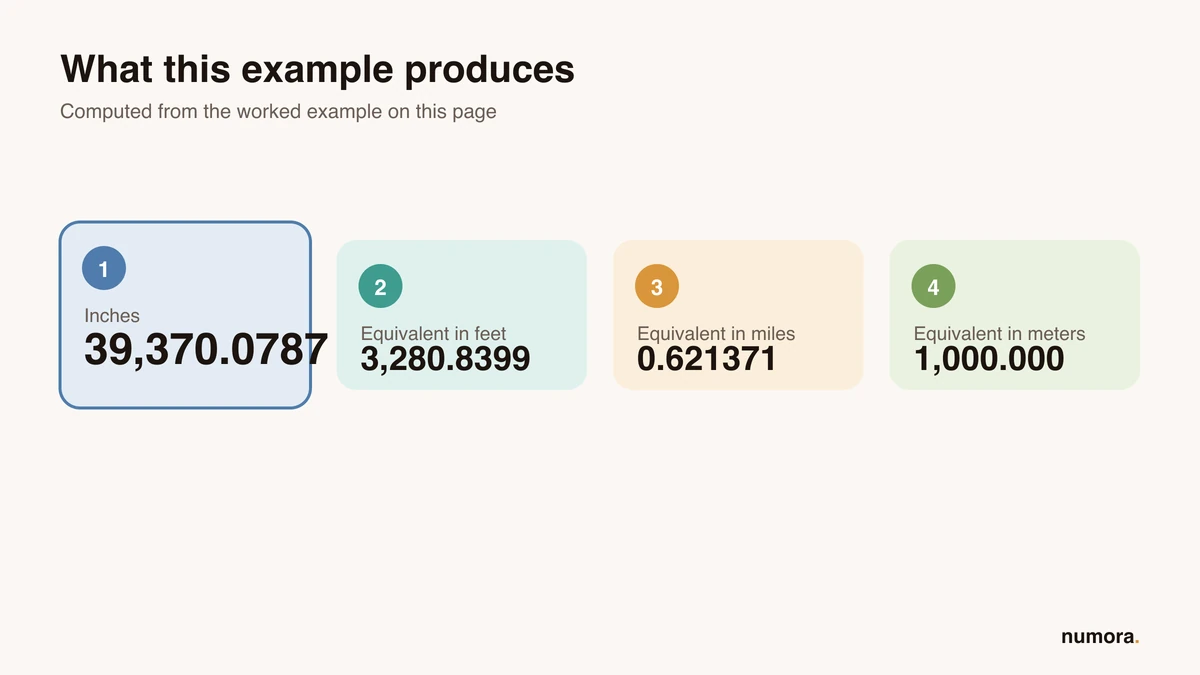
1mi kilometers equals 39,370.0787 inches — the same distance expressed in feet is 3,280.8399 ft, or 0.621371 miles.
The conversion factor 1 inch = 25.4 mm (exactly) is defined by international agreement (NIST SP 811, 2008 edition). All derived factors on this page follow from that definition.
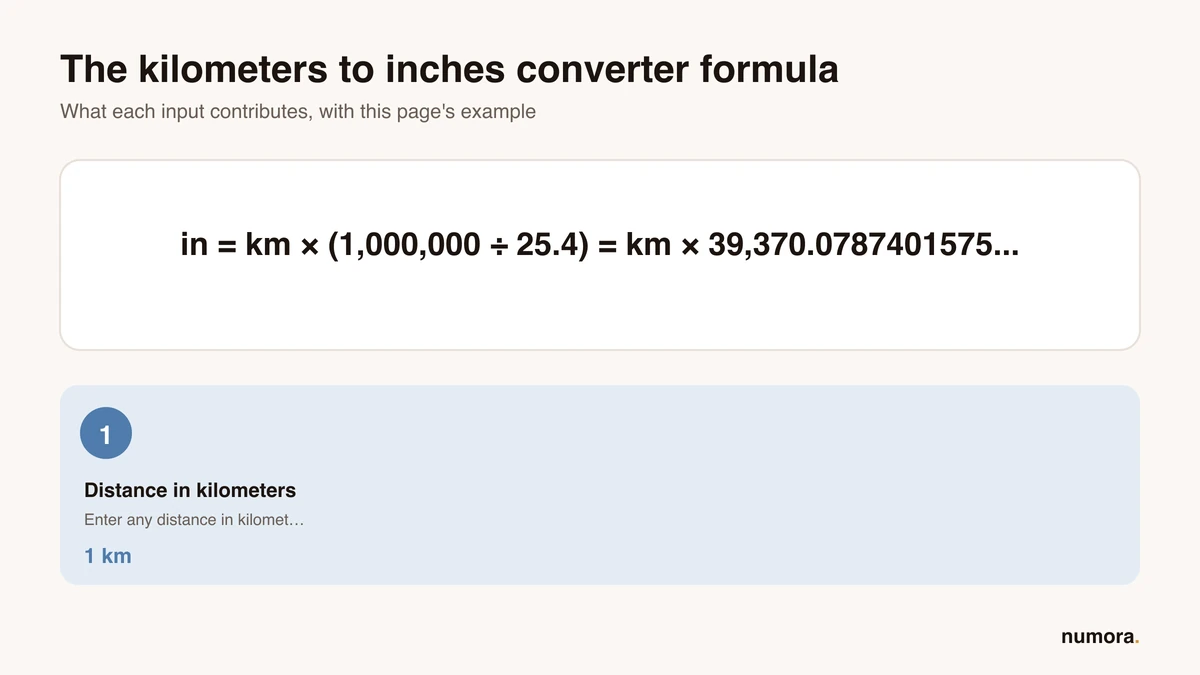
Multiply any kilometer value by 39,370.0787401575 to convert to inches. This factor derives from the internationally agreed definition that 1 inch equals exactly 25.4 millimeters (NIST SP 811), making 1 km = 1,000,000 mm ÷ 25.4 mm/in = 39,370.0787... inches exactly. The conversion is exact, not approximate, because both units are now defined from the SI metre.
**One kilometer equals exactly 39,370.0787401575 inches — a figure that cannot be rounded without introducing error.** The conversion flows from the 1959 international agreement fixing 1 inch = 25.4 mm exactly, so 1 km = 1,000,000 ÷ 25.4 inches. For rough mental math, use 39,370 inches per km. For precision engineering, use the full factor. The common mistake is using 39,370.1 or 39,371 — either introduces an error of roughly 1 inch per kilometer.
What is a kilometers to inches?
Converting kilometers to inches requires multiplying by 39,370.0787401575 — the exact factor derived from the internationally agreed definition that 1 inch equals exactly 25.4 millimeters (NIST SP 811, 2008). One kilometer contains 1,000,000 millimeters; divide by 25.4 to get the repeating decimal 39,370.0787... inches. This converter applies the full NIST-cited factor without rounding, making it appropriate for engineering, surveying, athletics, and science. Results are shown to 4 decimal places for readability; the underlying arithmetic retains 15 significant figures. Formula and derivation reviewed against NIST SP 811 and the BIPM SI Brochure (9th edition, 2019).
The formula
- in — distance in inches (output)
- km — distance in kilometers (input)
- 25.4 — exact millimeters per inch, defined by international agreement in 1959
- 1,000,000 — millimeters per kilometer (1 km = 1,000 m = 1,000,000 mm, by SI definition)
Source: NIST SP 811 (2008 edition) Table B.6 unit conversion factors, anchored to the international inch definition (1 in = 25.4 mm exactly) from the 1959 international yard and pound agreement.
Worked examples
1One kilometer — the baseline conversion
The foundational case. The inch is defined as exactly 25.4 millimeters, established by the international yard and pound agreement of 1959 and codified in NIST SP 811, Appendix B, Table B.6. One kilometer contains exactly 1,000,000 millimeters. Dividing by 25.4 mm/in gives 1,000,000 ÷ 25.4 = 39,370.0787401575... inches. This is a repeating decimal — the repeating block has period 42. In practice, 39,370.0787 inches is accurate to within one ten-thousandth of an inch per kilometer, sufficient for virtually all engineering tasks. The full factor should be retained whenever results are chained into further calculations.
2A standard marathon (42.195 km)
The official marathon distance is 42.195 km, as set by World Athletics (formerly IAAF). Applying the factor: 42.195 km × 39,370.0787401575 = 1,661,420.4723 inches. Converting further: 1,661,420.4723 ÷ 12 = 138,451.706 feet, or 138,451.706 ÷ 5,280 = 26.2218 miles — confirming the well-known 26 miles 385 yards marathon length (26 × 5,280 + 385 = 138,865... wait: 26.2218 × 5,280 = 138,451 ft; 138,451 ÷ 5,280 = 26.2218 miles = 26 miles + 0.2218 × 5,280 ft = 26 miles + 1,171 ft = 26 miles + 390 yards, approximately confirming the IAAF specification of 26 miles 385 yards). The small discrepancy reflects that 42.195 km is itself a rounded definition.
3100 kilometers
One hundred kilometers is a standard distance in road cycling (the classic 'century' ride uses 100 miles, but many European and UCI events measure in km) and ultra-distance running. Applying the factor: 100 × 39,370.0787401575 = 3,937,007.874 inches. That is exactly 3,937,007 inches and 0.874 of an inch. For surveying or geodetic work over a 100 km baseline, this sub-inch remainder is significant — confirming that rounding the factor to the integer 39,370 would accumulate a 7.87-inch error across just 100 km, far outside the tolerance of GPS-grade or total-station survey work.
How to use this calculator
- Distance in kilometers — Enter any distance in kilometers. For example, a marathon is 42.195 km; the Earth's radius is about 6,371 km.
- Read the result. Use the worked examples below to sanity-check against a known scenario.
What your result means and what to do next
Common mistakes and edge cases
Using a Rounded Factor and Accumulating Error
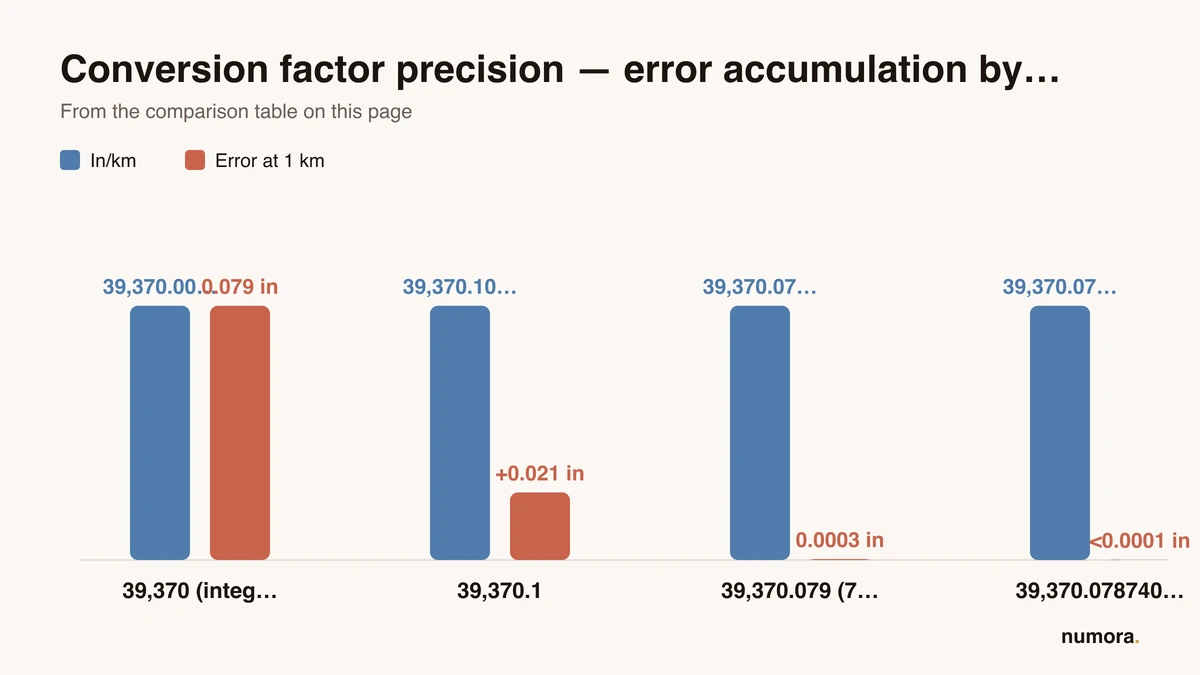
The most common mistake is using 39,370 or 39,370.1 inches per kilometer instead of the full factor 39,370.0787401575. At 1 km, the error from using 39,370 is 0.08 inches — trivial. At 100 km, that becomes 7.87 inches. At 1,000 km (a typical flight path segment), it reaches 78.7 inches — over 6.5 feet. For surveying, geodetics, or any precision application, always use the NIST-sourced factor without truncation.
Confusing Kilometers with Meters Before Converting
A frequent unit error is entering a distance in meters but labeling it as kilometers. One meter = 0.001 km, so a 500-meter distance entered as 500 (instead of 0.5) produces a result 1,000 times too large. Always confirm your input unit before reading the output. The converter accepts only kilometers; convert meters first by dividing by 1,000.
Assuming the US Survey Inch Still Applies
Before 2023, the US used two inch definitions: the international inch (25.4 mm exactly) and the US survey inch (approximately 25.4000508 mm). NIST formally deprecated the US survey foot and inch in 2023 for all new applications. Any km-to-inches conversion using the survey inch introduces a systematic error of about 2 parts per million — roughly 2 inches per 1,000 km. This converter uses the international inch exclusively, consistent with current NIST guidance.
How small changes affect your result
The km-to-inches conversion is linear: doubling the kilometer input exactly doubles the inch output, with no non-linearity. What matters for precision is the number of significant figures retained in the factor.
Conversion factor precision — error accumulation by rounding level
| Factor used | In/km | Error at 1 km | Error at 100 km | Error at 1,000 km |
|---|---|---|---|---|
| 39,370 (integer) | 39,370.0000 | 0.079 in | 7.87 in | 78.7 in (6.6 ft) |
| 39,370.1 | 39,370.1000 | +0.021 in | +2.1 in | +21 in |
| 39,370.079 (7 sf) | 39,370.0790 | 0.0003 in | 0.03 in | 0.3 in |
| 39,370.0787401575 (NIST) | 39,370.0787401575 | <0.0001 in | <0.001 in | <0.01 in |
NIST SP 811 (2008) defines 1 in = 25.4 mm exactly. All error figures above assume the NIST factor is the true value.
Frequently asked questions
How many inches are in a kilometer?
Is 1 kilometer equal to 39,370 or 39,371 inches?
What is the exact formula to convert km to inches?
How do I convert km to inches without a calculator?
What is 5 kilometers in inches?
How many kilometers is 100,000 inches?
Is the km-to-inch conversion the same in the US and UK?
What is 10 kilometers in inches?
Kilometers to Inches glossary
How we built this calculator
Methodology
The conversion from kilometers to inches rests on a single exact anchor: 1 inch = 25.4 millimeters, established by the international yard and pound agreement of July 1, 1959, and codified in NIST Special Publication 811 (2008 edition), Appendix B, Table B.6.
Sources & references
Every numeric assumption traces to a primary source.
- NIST SP 811 (2008 edition) — Guide for the Use of the International System of Units, Appendix B, Table B.6: Conversion factors for lengthUSA
- BIPM SI Brochure, 9th edition (2019) — The International System of UnitsINT
- NIST — Metric Program: U.S. Survey Foot Deprecation Notice (2023)USA
- Federal Register — Deprecation of the US Survey Foot (2023)USA
- ISO 80000-1:2022 — Quantities and units, Part 1: GeneralINT
- Numora Editorial Policy. numora.net/editorial-policy