Hair Developer Mixing Ratio Calculator: Compute Exact Developer and Colour Weights
Calculate exact developer and colour volumes from any mixing ratio and total target weight
Try the calculator
Math runs in your browser. No sign-up.
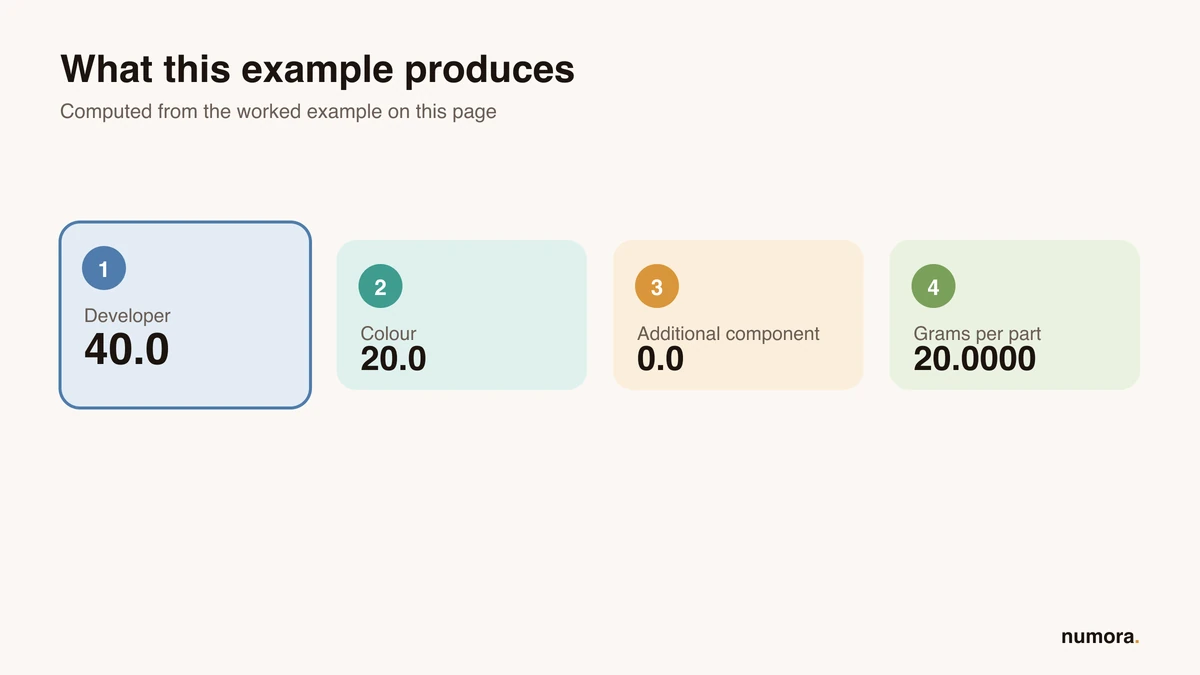
Grams of developer to weigh
For a 2:1 developer-to-colour ratio at 60oz of total mix: weigh 40 of developer and 20 of colour. Each part weighs 20.
This calculator performs proportion arithmetic only. It does not account for product density differences between developer and colour formulations. All results are by weight (grams). Volume measurements differ from weight measurements — always weigh on a scale for precision. No claim is made about colouring outcomes, safety, or suitability for any application.
A hair developer mixing ratio is solved by dividing the target total weight by the sum of all parts, then multiplying each component's part count by that quotient. For a 1:2 colour-to-developer ratio with a 60 g target, each part weighs 20 g, giving 20 g colour and 40 g developer. The formula is pure proportion arithmetic — no empirical constants are involved.
**A mixing ratio is a parts-to-parts proportion: divide your target weight by the total number of parts to get grams per part, then multiply each component's parts by that number.** For a standard 1:2 ratio at 60 g total, each part is 20 g — so 20 g colour and 40 g developer. If a product requires a 1:1.5 ratio, the same logic gives 24 g colour and 36 g developer from 60 g total. The only arithmetic involved is division and multiplication; no constants change.
What is a hair developer mixing ratio?
A hair developer mixing ratio calculator converts a parts-based ratio (such as 1:2 colour-to-developer) and a target total weight into exact gram measurements for each component. The underlying arithmetic is linear proportion: divide the target weight by the total number of parts, then multiply by each component's part count. The formula is sourced to NIST SP 811 (2008), Section 7.4, which defines ratio quantities in the International System of Units. Enter your ratio and target weight below to get component weights immediately — no rounding of intermediate values.
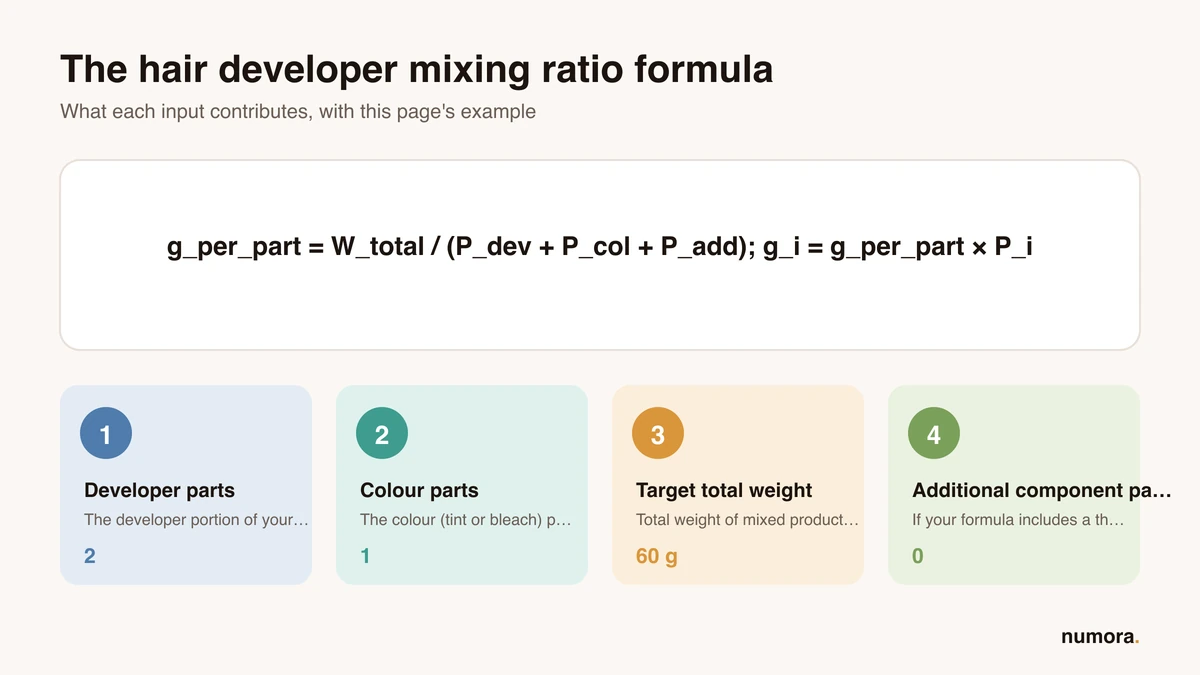
The formula
- W_total — target total weight of mixed product, in grams
- P_dev — number of parts assigned to developer
- P_col — number of parts assigned to colour or bleach
- P_add — number of parts assigned to any additional component (0 if unused)
- g_per_part — weight in grams corresponding to one part
- g_i — weight in grams of component i
Source: Linear proportion formula: g_per_part = W_total / (P_dev + P_col + P_add); g_i = g_per_part × P_i. This is a direct application of ratio arithmetic as defined in NIST SP 811 (2008), Section 7.4..
Worked examples
1Standard 1:2 colour-to-developer ratio at 60 g
This is the most common mixing instruction on permanent colour packaging. The ratio is 1 part colour to 2 parts developer, so there are 1 + 2 = 3 total parts. Step 1 — compute grams per part: g_per_part = 60 / 3 = 20.0 g exactly. Step 2 — scale each component: colour = 20.0 × 1 = 20.0 g; developer = 20.0 × 2 = 40.0 g. Verification: 20.0 + 40.0 = 60.0 g. No rounding occurs at any step because 60 is exactly divisible by 3. The result is an exact anchor: 20 g colour, 40 g developer.
21:1.5 ratio at 50 g — a non-integer ratio
Some products specify non-integer ratios such as 1:1.5. Total parts = 1 + 1.5 = 2.5. Step 1 — g_per_part = 50 / 2.5 = 20.0 g exactly. Step 2 — colour = 20.0 × 1 = 20.0 g; developer = 20.0 × 1.5 = 30.0 g. Verification: 20.0 + 30.0 = 50.0 g. The ratio 1:1.5 is equivalent to 2:3, confirming 2/5 and 3/5 of 50 g respectively. This example illustrates that decimal part values are handled identically — the formula is agnostic to whether parts are integers or not.
3Three-component mix: colour, developer, and booster at 90 g
When a third component is specified (a bond-builder additive, booster, or second colour) the formula extends naturally. Here the ratio is 1 colour : 2 developer : 0.5 additional. Total parts = 1 + 2 + 0.5 = 3.5. Step 1 — g_per_part = 90 / 3.5 = 25.714285… g (non-terminating decimal; full precision is preserved internally). Step 2 — colour = 25.714285… × 1 = 25.7 g (rounded to 0.1 g for the scale reading); developer = 25.714285… × 2 = 51.4 g; additional = 25.714285… × 0.5 = 12.9 g. Verification at full precision: 25.714285… + 51.428571… + 12.857142… = 90.000000 g. The rounding to 0.1 g in the display introduces at most 0.3 g of aggregate rounding — well within practical weighing tolerance on a 0.1 g precision scale.
How to use this calculator
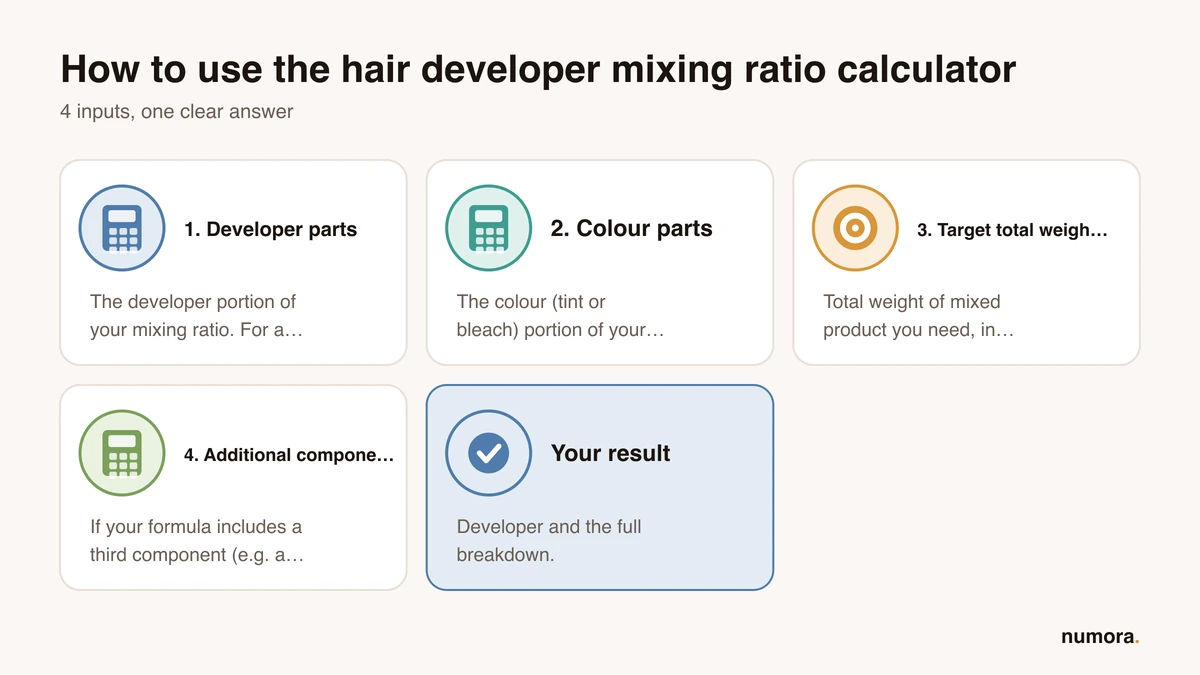
- Developer parts — The developer portion of your mixing ratio. For a 1:2 colour-to-developer ratio, enter 2 here.
- Colour parts — The colour (tint or bleach) portion of your mixing ratio. For a 1:2 colour-to-developer ratio, enter 1 here.
- Target total weight — Total weight of mixed product you need, in grams. A single full-head application typically needs 60–120 g; a root touch-up 30–60 g.
- Additional component parts — If your formula includes a third component (e.g. a booster or bond-builder), enter its parts here. Leave as 0 if not applicable.
- Read the result. Use the worked examples below to sanity-check against a known scenario.
Common mistakes and edge cases
Confusing weight-based and volume-based ratios
The most common error is measuring by volume when the ratio is specified by weight, or vice versa. Developer (typically an aqueous hydrogen peroxide solution) has a density close to but not exactly 1.0 g/mL at 20°C; colour cream bases contain thickeners and have a higher density. A 1:2 volume ratio and a 1:2 weight ratio are therefore not equivalent. This calculator operates by weight. If your scale reads in grams and your product's instructions specify the ratio by weight, the results are directly applicable. If the product specifies 'by volume', measure with graduated cylinders or measuring cups instead — do not use this calculator's gram outputs as millilitre equivalents.
Reading the ratio in the wrong order
A ratio written as 1:2 on a product label typically means 1 part colour to 2 parts developer, in that order. Reading it as 2 parts colour to 1 part developer doubles the amount of colour and halves the developer — a substantial formulation error. Always confirm which component is listed first in the product's ratio specification before entering values. Many professional product guides specify the ratio as 'colour : developer'.
Assuming all ratios are integer values
Product ratios such as 1:1.5 or 1:2.5 are common. The proportion formula handles non-integer parts identically to integer parts — just enter the decimal value. The error arises when practitioners mentally round 1:1.5 to 1:2 or 1:1 'because it is easier', which introduces a systematic formulation error of between 10% and 25% of the developer weight. Use the actual specified value.
Rounding intermediate values
If you round the grams-per-part figure before multiplying to get component weights, rounding errors accumulate. The calculator preserves full floating-point precision through all intermediate steps and only rounds the final displayed values. When working by hand, carry at least four decimal places in the intermediate step and round only the final measurement to the precision of your scale.
Using the same bowl weight for every step
This is a physical measurement error rather than an arithmetic one, but it compounds the formula: if you tare the scale with the bowl, add developer, record the weight, then remove developer and re-tare before adding colour, any residue from the developer introduces a systematic positive error in the colour weight. Weigh each component into a separate container, or add sequentially and subtract: weigh bowl + developer, record, then add colour and subtract developer weight to confirm the colour addition.
How small changes affect your result
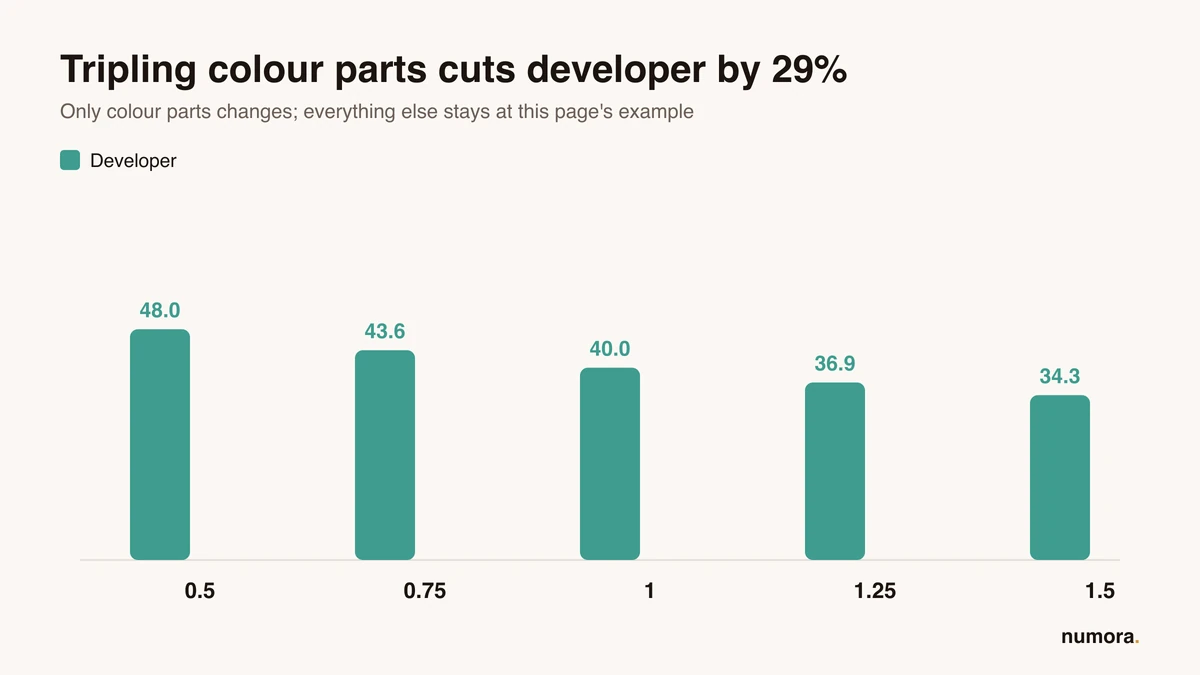
Because the formula is a linear proportion, every component weight scales exactly linearly with the target total weight. There are no non-linear interactions.
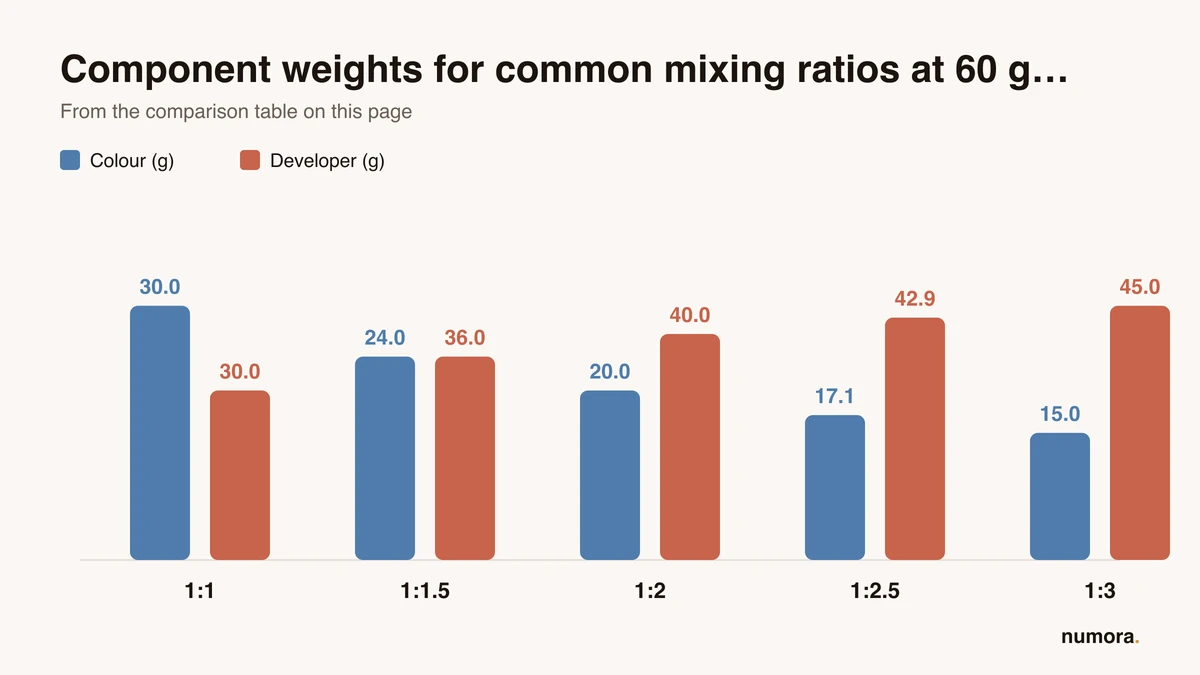
Component weights for common mixing ratios at 60 g total target weight
| Ratio (colour : developer) | Colour (g) | Developer (g) | Total parts |
|---|---|---|---|
| 1:1 | 30.0 | 30.0 | 2 |
| 1:1.5 | 24.0 | 36.0 | 2.5 |
| 1:2 | 20.0 | 40.0 | 3 |
| 1:2.5 | 17.1 | 42.9 | 3.5 |
| 1:3 | 15.0 | 45.0 | 4 |
All values are by weight (grams). Target total = 60 g in every case. Computed using g_per_part = 60 / (colour_parts + developer_parts).
Frequently asked questions
What does a 1:2 hair colour mixing ratio mean?
Should I mix hair developer by weight or by volume?
What is a 1:1 hair colour ratio used for?
Can I scale a mixing ratio to any amount?
What if my product uses a three-part ratio like 1:2:0.5?
How accurate does my scale need to be?
Does this calculator account for developer volume strength (10 Vol, 20 Vol, 30 Vol)?
Why is my verification total not exactly equal to my target weight?
Hair Developer Mixing Ratio glossary
How we built this calculator
Methodology
The calculator applies a single arithmetic operation: it divides the target total weight by the sum of all parts to find the weight of one part, then multiplies by each component's part count.
Sources & references
Every numeric assumption traces to a primary source.
- NIST SP 811 (2008, corrected 2009): Guide for the Use of the International System of Units — Section 7.4 (Ratio quantities, dimensionless quantities)USA
- NIST Handbook 44 (2026): Specifications, Tolerances, and Other Technical Requirements for Weighing and Measuring Devices — Section 2.20 (Scales)USA
- BIPM — International Vocabulary of Metrology (VIM), 3rd edition (2012): definition of 'quantity ratio' (entry 1.22)INT
- ISO 80000-1:2022 — Quantities and units — Part 1: General (defines dimensionless ratio quantities, Section 6.5.5)INT
- Numora Editorial Policy. numora.net/editorial-policy