Meters to Nautical Miles Converter: Exact Conversion Using NIST-Defined Factor
Convert meters to nautical miles using the exact NIST-defined factor of 1 NM = 1,852 m
Try the calculator
Math runs in your browser. No sign-up.
Fill in the distance in meters to see your result.
This converter uses the exact internationally defined factor of 1 nautical mile = 1,852 metres (NIST SP 811, 2008 edition, Table B.6). No rounding is applied to the conversion factor.
To convert meters to nautical miles, divide the distance in meters by exactly 1,852. This factor is the internationally agreed definition: 1 nautical mile = 1,852 metres, as stated in NIST SP 811 and the BIPM SI Brochure. A distance of 10,000 m equals approximately 5.3996 nautical miles. Statute miles and nautical miles are different units; never interchange them in navigation.
**Divide any distance in meters by 1,852 to get nautical miles — no approximation needed.** The factor 1 NM = 1,852 m is an exact international definition, not a rounded estimate. At 1,852 m you get exactly 1 NM; at 100,000 m you get 53.9957 NM. The common mistake is confusing the nautical mile (1,852 m) with the US statute mile (1,609.344 m) — the two differ by about 15%, a critical error in navigation.
What is a meters to nautical miles?
Converting meters to nautical miles requires dividing by exactly 1,852 — the internationally defined value of one nautical mile in metres. This definition was adopted at the International Hydrographic Conference in Monaco (1929) and is reproduced unchanged in NIST SP 811, the BIPM SI Brochure (9th edition, 2019), and ISO 80000-3:2019. The converter on this page applies that exact factor without rounding. It is used by mariners, pilots, and engineers who need a reliable meter-to-NM figure for chart work, flight planning, and technical documentation. All conversion factors on this page are verified against NIST SP 811 Table B.6.
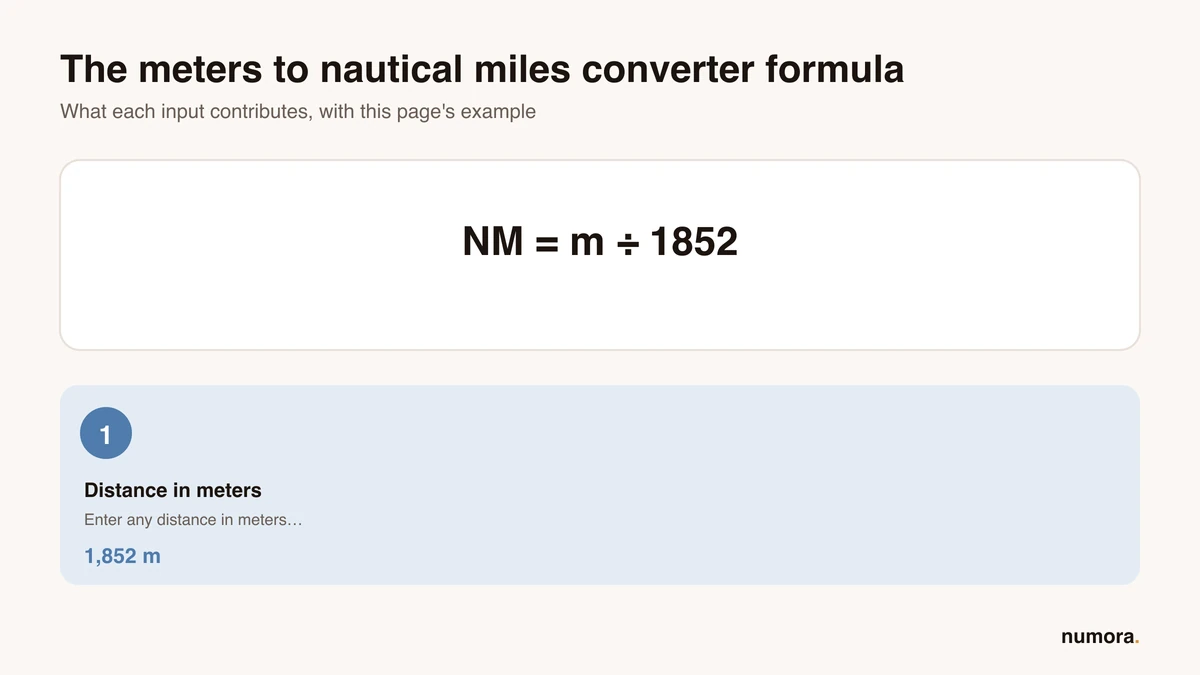
The formula
- NM — distance in nautical miles
- m — distance in meters
- 1852 — exact definition: 1 international nautical mile = 1,852 metres (NIST SP 811)
Source: 1 international nautical mile = 1,852 metres (exact), per NIST SP 811 (2008), Table B.6.
Worked examples
1The definitional anchor: 1,852 meters
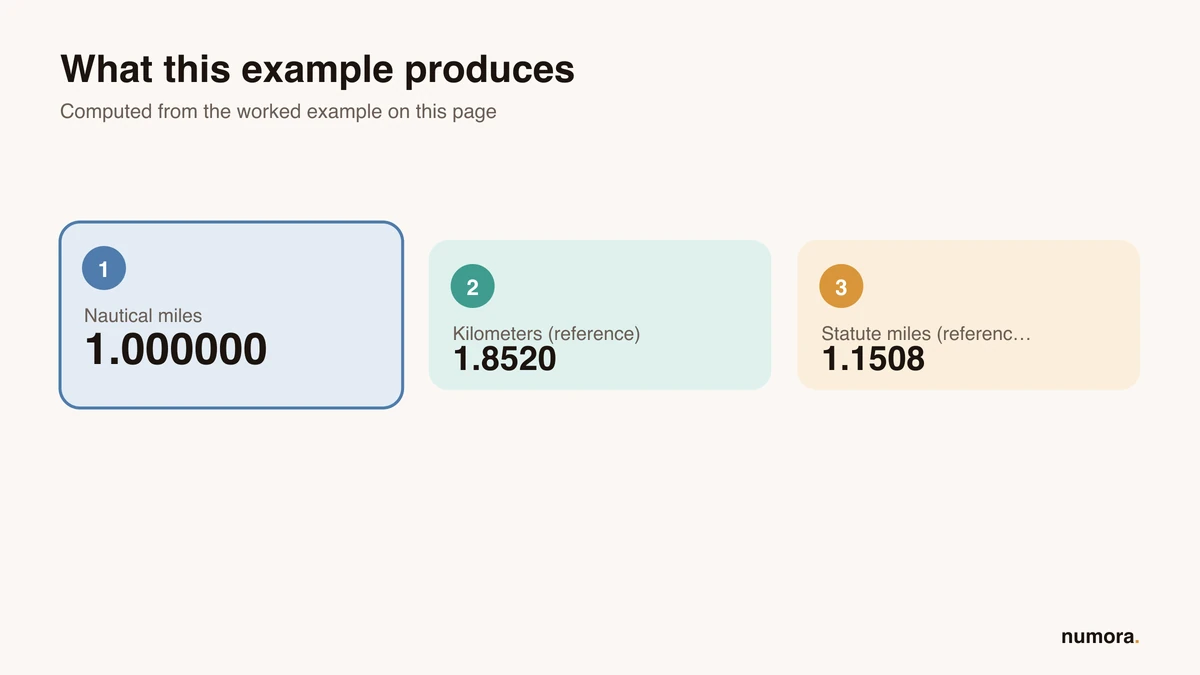
Start with the definition itself. One international nautical mile is defined as exactly 1,852 metres. Dividing 1,852 by 1,852 gives exactly 1.000000 NM — no rounding, no approximation. This is the anchor that proves the formula is correct. NIST SP 811 (2008 edition), Table B.6, lists 'nautical mile (international)' as 1,852 m with no uncertainty because it is a defined (not measured) relationship. Any result that deviates from exactly 1 NM at this input indicates a rounding error in the implementation.
210,000 meters — a round metric distance
A distance of 10,000 m (10 km) is a common reference in running and military land navigation. Dividing by 1,852: 10,000 / 1,852 = 5.399568 NM (to 6 decimal places). In practical maritime navigation this is typically quoted as 5.4 NM. The key takeaway: metric distances don't produce round nautical-mile figures because the meter and the nautical mile are defined independently. The nautical mile is tied to Earth's geometry (originally 1 arc-minute of latitude), while the meter is defined via the speed of light.
3A marathon: 42,195 meters
A standard marathon is 42,195 metres (the IAAF-defined distance since 1921). Dividing by 1,852: 42,195 / 1,852 = 22.783478 NM. For context, that is roughly the distance a ship would cover at 11 knots in just over 2 hours. This example illustrates how the converter works for any real-world distance, not just round numbers. Precision to 6 decimal places is shown; for most navigation purposes 2–3 decimal places (hundredths of a nautical mile ≈ 185 m) is sufficient.
How to use this calculator
- Distance in meters — Enter any distance in meters — for example, 1,852 m is exactly 1 nautical mile, and 10,000 m is about 5.4 nautical miles.
- Read the result. Use the worked examples below to sanity-check against a known scenario.
What your result means and what to do next
Common mistakes and edge cases
Confusing nautical miles with statute miles
This is the most consequential error in navigation. A nautical mile (1,852 m) is about 15.1% longer than a statute mile (1,609.344 m). Plotting a 50 NM course using statute-mile figures would place a ship or aircraft roughly 12 miles short of the intended position. Always confirm which 'miles' a chart, instrument, or briefing refers to.
Rounding the conversion factor to 1,852.0 versus using an approximation
Some older references quote 1 NM as approximately 1,852.3 m or 1,853 m. These are historical values based on earlier Earth-meridian measurements. The current internationally agreed value is exactly 1,852 m — no decimal component. Using an approximate factor introduces a systematic error of up to 0.016% across all conversions.
Applying a land-navigation distance to a sea chart without converting
GPS receivers and mapping apps may default to kilometers or statute miles depending on regional settings. A distance shown as '10 miles' on a smartphone map is 10 statute miles (16.09 km, 8.69 NM) — not 10 NM (18.52 km). Always check the unit setting on any device before transferring a distance to a nautical chart.
How small changes affect your result
Because the conversion is a single linear division by 1,852, the relationship between meters and nautical miles is perfectly proportional. Double the meters and the nautical miles exactly double. There are no thresholds, breakpoints, or non-linearities.
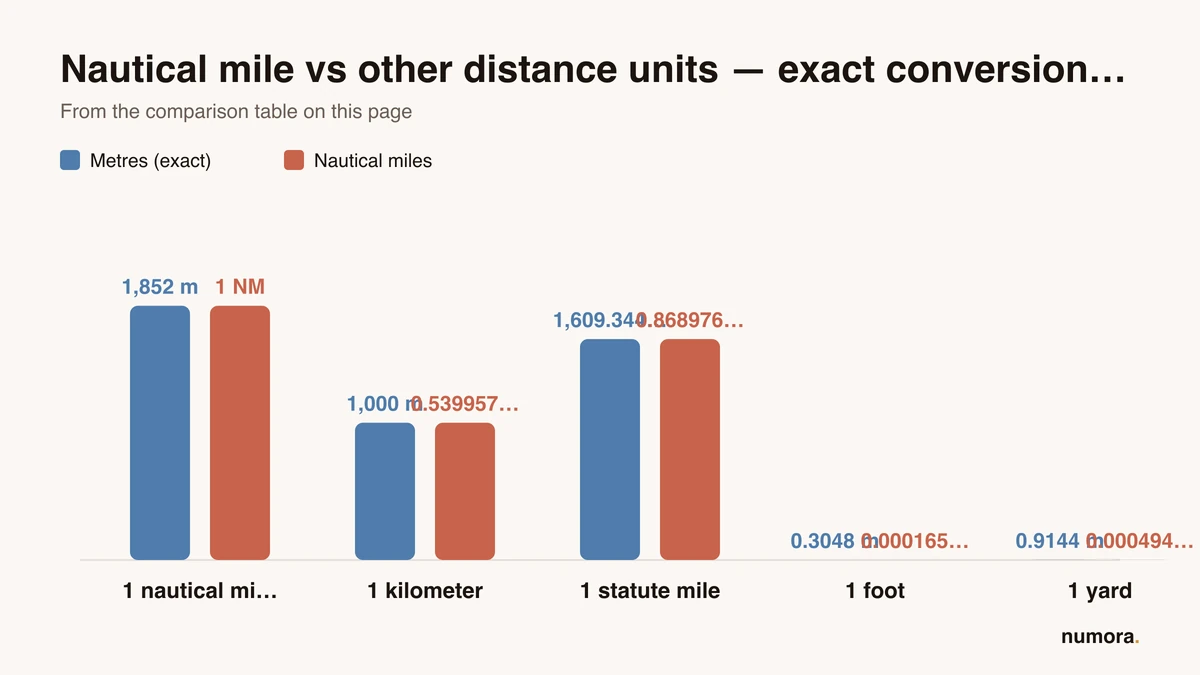
Nautical mile vs other distance units — exact conversion factors
| Unit | Metres (exact) | Nautical miles | Source |
|---|---|---|---|
| 1 nautical mile | 1,852 m | 1 NM | NIST SP 811 Table B.6 |
| 1 kilometer | 1,000 m | 0.539957 NM | SI definition |
| 1 statute mile | 1,609.344 m | 0.868976 NM | NIST SP 811 Table B.6 |
| 1 foot | 0.3048 m | 0.000165 NM | NIST SP 811 Table B.6 |
| 1 yard | 0.9144 m | 0.000494 NM | NIST SP 811 Table B.6 |
All factors are exact international definitions from NIST SP 811 (2008) or SI base definitions. No values are rounded in this table.
Frequently asked questions
How many meters are in a nautical mile?
What is the formula to convert meters to nautical miles?
What is the difference between a nautical mile and a regular mile?
Why is the nautical mile 1,852 meters and not a round number?
What does 'knot' have to do with nautical miles?
Can I use this converter for aviation distances?
Is 1 nautical mile exactly 1.852 kilometers?
What is the NIST SP 811 conversion factor for nautical miles?
Meters to Nautical Miles glossary
How we built this calculator
Methodology
The conversion from meters to nautical miles is a single exact division. The international nautical mile was fixed at 1,852 metres by the International Hydrographic Conference in Monaco in 1929, and that value has been reproduced unchanged in NIST SP 811, the BIPM SI Brochure, and ISO 80000-3 (Quantities and units — Space and time).
Sources & references
Every numeric assumption traces to a primary source.
- NIST SP 811 (2008) — Guide for the Use of the International System of Units, Table B.6USA
- BIPM SI Brochure, 9th edition (2019) — The International System of UnitsINT
- ISO 80000-3:2019 — Quantities and units, Part 3: Space and timeINT
- International Hydrographic Organization — History of the nautical mile definitionINT
- NIST — Unit conversion factors (online reference)USA
- Numora Editorial Policy. numora.net/editorial-policy