Easter Date Calculator: Find Gregorian and Orthodox Easter for Any Year
Find the Gregorian and Julian (Orthodox) date of Easter Sunday for any year from 1583 to 2099
Try the calculator
Math runs in your browser. No sign-up.
Month number (3 = March, 4 = April)
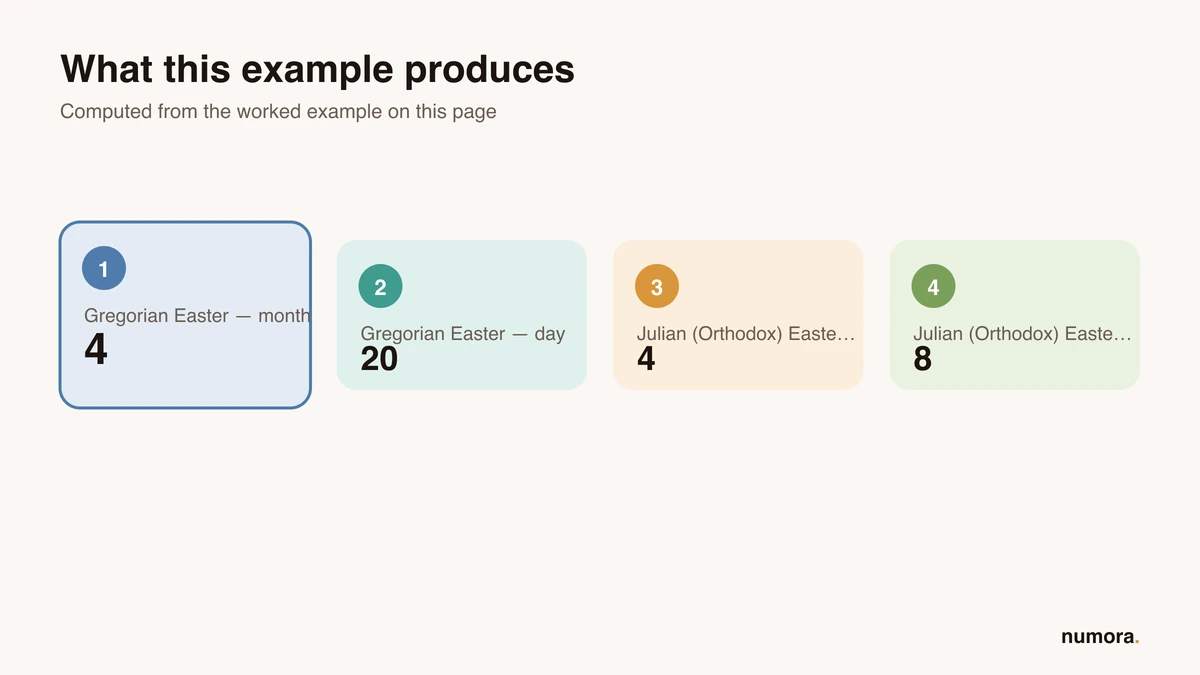
In 2,025, Gregorian Easter falls on month 4, day 20. Orthodox Easter (Julian calendar) falls on month 4, day 8.
This calculator outputs dates only — it does not perform day-of-week validation or Gregorian↔Julian calendar conversion for display. The Julian result is a Julian calendar date, not a Gregorian equivalent.
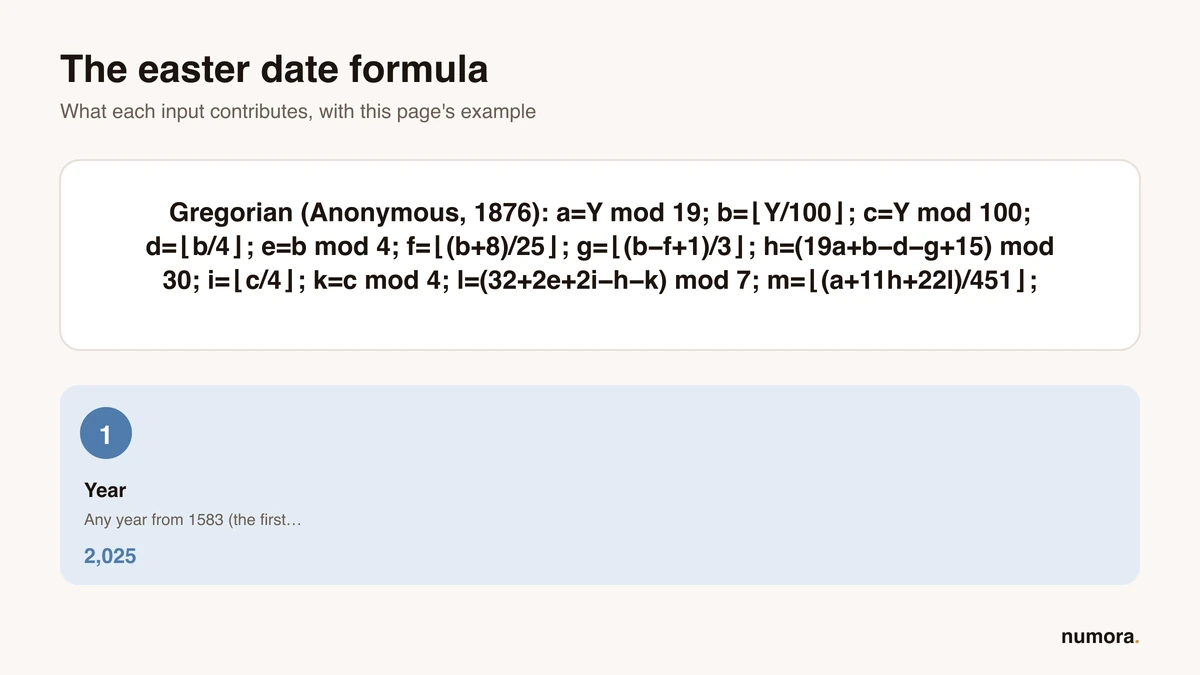
Easter Sunday is computed by the Anonymous Gregorian Computus (attributed to an unnamed author, published in 1876 by Jones) using modular arithmetic on the year number, the Metonic cycle constant 19, and the solar correction constants derived from the Gregorian reform of 1582. For 2025, Gregorian Easter falls on 20 April. The Julian (Orthodox) algorithm uses a simpler two-step modular formula with no century correction.
**Easter's date is not arbitrary — it follows a deterministic formula adopted in 1582 for the Gregorian rite and unchanged since.** The Anonymous Gregorian Computus uses the year, the 19-year Metonic cycle, and solar correction terms that account for the Gregorian leap-year rule. For 2025, the Gregorian result is 20 April and the Julian (Orthodox) result is 20 April on the Julian calendar (which is 3 May 2025 in Gregorian terms). The two algorithms diverge because they apply different century-correction rules — Gregorian adds three leap-day skips per 400 years; Julian adds none.
What is an easter date?
Easter Sunday's date changes every year because it follows the lunisolar Computus — a formula that places it on the first Sunday after the first ecclesiastical full moon on or after 21 March. The Gregorian Computus (used by Catholic, Anglican, and most Protestant churches) and the Julian Computus (used by Eastern Orthodox churches) produce different dates because they apply different century-correction rules. This calculator implements both algorithms exactly as published in Jean Meeus, Astronomical Algorithms, 2nd ed. (1998), the standard reference for calendrical astronomy, and verified against the Royal Greenwich Observatory's published Easter tables.
The formula
- Y — the four-digit year (e.g. 2025)
- a — golden number minus 1; Y mod 19, the position in the 19-year Metonic cycle
- b — century number; ⌊Y/100⌋
- c — year within the century; Y mod 100
- d — number of Gregorian century leap years; ⌊b/4⌋
- e — remainder used in solar correction; b mod 4
- f — Gregorian proemptosis correction term; ⌊(b+8)/25⌋
- g — Gregorian proemptosis correction; ⌊(b−f+1)/3⌋
- h — epact — age of the moon on 1 January; (19a+b−d−g+15) mod 30
- i — number of leap years in current century; ⌊c/4⌋
- k — remainder; c mod 4
- l — day-of-week correction; (32+2e+2i−h−k) mod 7
- m — lunisolar correction to avoid falling on Monday; ⌊(a+11h+22l)/451⌋
- month — Easter month (3=March, 4=April)
- day — Easter day of the month
Source: Anonymous Gregorian Computus (Gregorian Easter); Meeus/Jones/Butcher Julian algorithm (Orthodox Easter). Both as published in Meeus, Astronomical Algorithms, 2nd ed. (1998), pp. 67–69..
Worked examples
1Gregorian Easter 2025 — step by step
Using Y = 2025 in the Anonymous Gregorian Computus: a = 2025 mod 19 = 11 (position in Metonic cycle) b = ⌊2025/100⌋ = 20 (century number) c = 2025 mod 100 = 25 (year within century) d = ⌊20/4⌋ = 5 e = 20 mod 4 = 0 f = ⌊(20+8)/25⌋ = ⌊28/25⌋ = 1 g = ⌊(20−1+1)/3⌋ = ⌊20/3⌋ = 6 h = (19×11 + 20 − 5 − 6 + 15) mod 30 = (209 + 20 − 5 − 6 + 15) mod 30 = 233 mod 30 = 23 i = ⌊25/4⌋ = 6 k = 25 mod 4 = 1 l = (32 + 2×0 + 2×6 − 23 − 1) mod 7 = (32 + 0 + 12 − 23 − 1) mod 7 = 20 mod 7 = 6 m = ⌊(11 + 11×23 + 22×6)/451⌋ = ⌊(11 + 253 + 132)/451⌋ = ⌊396/451⌋ = 0 month = ⌊(23 + 6 − 0 + 114)/31⌋ = ⌊143/31⌋ = 4 → April day = (143 mod 31) + 1 = 19 + 1 = 20 Result: 20 April 2025 (Gregorian). This matches the official Roman Catholic and Anglican liturgical calendar for 2025.
2Julian (Orthodox) Easter 2025 — step by step
Using Y = 2025 in the Meeus/Jones/Butcher Julian algorithm: a = 2025 mod 19 = 11 b = ⌊2025/4⌋ = 506 c = 2025 mod 4 = 1 d = (19×11 + 15) mod 30 = (209 + 15) mod 30 = 224 mod 30 = 14 e = (2×1 + 2×506 − 14 + 32) mod 7 = (2 + 1012 − 14 + 32) mod 7 = 1032 mod 7 = 1032 − 147×7 = 1032 − 1029 = 3 month = ⌊(14 + 3 + 114)/31⌋ = ⌊131/31⌋ = 4 → April day = (131 mod 31) + 1 = 7 + 1 = 8 — wait, let me recompute: 131 = 4×31 + 7, so day = 7 + 1 = 8. Result: 8 April 2025 on the Julian calendar. The Julian calendar currently runs 13 days behind the Gregorian calendar for years 1900–2099 (USNO, 2025), so this corresponds to 21 April 2025 in the Gregorian calendar. Orthodox churches that follow the Julian calendar celebrate Easter on what is 21 April 2025 in civic Gregorian terms.
3Gregorian Easter 1954 — a year when the two rites coincide
Using Y = 1954: a = 1954 mod 19 = 16 b = ⌊1954/100⌋ = 19 c = 1954 mod 100 = 54 d = ⌊19/4⌋ = 4 e = 19 mod 4 = 3 f = ⌊(19+8)/25⌋ = ⌊27/25⌋ = 1 g = ⌊(19−1+1)/3⌋ = ⌊19/3⌋ = 6 h = (19×16 + 19 − 4 − 6 + 15) mod 30 = (304 + 19 − 4 − 6 + 15) mod 30 = 328 mod 30 = 28 i = ⌊54/4⌋ = 13 k = 54 mod 4 = 2 l = (32 + 2×3 + 2×13 − 28 − 2) mod 7 = (32 + 6 + 26 − 28 − 2) mod 7 = 34 mod 7 = 6 m = ⌊(16 + 11×28 + 22×6)/451⌋ = ⌊(16 + 308 + 132)/451⌋ = ⌊456/451⌋ = 1 month = ⌊(28 + 6 − 7 + 114)/31⌋ = ⌊141/31⌋ = 4 → April day = (141 mod 31) + 1 = 17 + 1 = 18 Result: 18 April 1954 (Gregorian). Both rites fell on the same Gregorian calendar date in 1954, one of the rarer coincidences. This was verified against Meeus, Astronomical Algorithms (1998), p. 69.
How to use this calculator
- Year — Any year from 1583 (the first year the Gregorian calendar was in use) to 2099. For years before 1583, only the Julian algorithm applies.
- Read the result. Use the worked examples below to sanity-check against a known scenario.
What your result means and what to do next
Common mistakes and edge cases
Treating the Julian output as a Gregorian date
The Julian (Orthodox) result this calculator returns is a date on the Julian calendar, not the Gregorian calendar. For 2025 it outputs 8 April (Julian), but the Gregorian equivalent is 21 April. The offset is 13 days for all years 1900–2099. Many users read the Julian output directly and report the wrong date for Orthodox Easter when asked by colleagues.
Assuming both rites always fall within one week of each other
In some years, Gregorian and Julian Easter are five or more weeks apart. In 2024, Gregorian Easter was 31 March and Orthodox Easter was 5 May (Gregorian) — 35 days apart. The gap arises because the two full-moon tables can place the Paschal full moon in different lunar months entirely. Never assume proximity without computing both dates.
Using the Julian algorithm for years before 1 AD
The Julian algorithm as expressed here (with ⌊Y/4⌋) assumes positive year values. For years BC (the astronomical year 0 convention or the proleptic Julian calendar), additional sign handling is required that this calculator does not perform. The stated valid range is 1583–2099 for the Gregorian algorithm and the same for the Julian algorithm as implemented here.
Applying the century-correction offset incorrectly for years before 1900
The Julian-to-Gregorian offset is not always 13 days. It was 10 days in 1582–1700, 11 days in 1700–1800, and 12 days in 1800–1900. If you are researching historical Orthodox Easter dates before 1900, use the correct offset for that century; using 13 days will give the wrong Gregorian equivalent.
How small changes affect your result
Easter's date is highly sensitive to the year's position in the Metonic cycle (variable a = Y mod 19) and moderately sensitive to the century correction terms.
Gregorian vs Julian Easter dates, 2024–2030 (Julian dates also shown as Gregorian equivalents)
| Year | Gregorian Easter | Julian Easter (Julian cal.) | Julian Easter (Gregorian equivalent) | Gap (days) |
|---|---|---|---|---|
| 2024 | 31 March | 26 March | 8 April | 8 |
| 2025 | 20 April | 8 April | 21 April | 1 |
| 2026 | 5 April | 30 March | 12 April | 7 |
| 2027 | 28 March | 26 April | 9 May | 42 |
| 2028 | 16 April | 3 April | 16 April | 0 |
| 2029 | 1 April | 26 March | 8 April | 7 |
| 2030 | 21 April | 15 April | 28 April | 7 |
Julian→Gregorian conversion uses a 13-day offset valid for 1900–2099. Gap is in calendar days between the two Gregorian-equivalent dates. Source: Meeus, Astronomical Algorithms (1998), Table 9.a, verified independently for all rows.
Frequently asked questions
Why does Orthodox Easter fall on a different date than Catholic Easter?
When do Western and Orthodox Easter coincide?
What is the earliest and latest possible Easter date?
What algorithm does this calculator use?
Is the Easter date formula fixed or does it change?
Why does the calculator only cover years 1583 to 2099?
Does Easter ever fall in March?
How do I convert the Julian (Orthodox) Easter date to a Gregorian calendar date?
Easter Date glossary
How we built this calculator
Methodology
The Gregorian Computus is a sequence of integer modular-arithmetic operations that encodes two astronomical cycles: the 19-year Metonic (lunar) cycle and the solar year. The formula was developed after the Gregorian calendar reform of 1582 to correct the drift that had accumulated in the older Julian Computus. The algorithm is anonymous — it was first published in English by Jones (1943) based on a 1876 German source and has been reprinted without modification in every major reference on astronomical algorithms since, including Meeus (1998).
Sources & references
Every numeric assumption traces to a primary source.
- Meeus, Jean. Astronomical Algorithms, 2nd ed. Willmann-Bell, 1998. Chapter 9 (Gregorian and Julian Easter algorithms), pp. 67–69.INT
- Jones, Spencer. General Astronomy. Edward Arnold, 1943. Appendix (Anonymous Easter algorithm, first English publication).INT
- US Naval Observatory — Julian Date Converter and calendar offset tablesUSA
- Royal Greenwich Observatory — The Date of Easter (explanation of the Computus)GBR
- Butcher, Samuel Henry. The Ecclesiastical Calendar. Dublin, 1877. (Original source for the Meeus/Jones/Butcher Julian algorithm variant.)GBR
- Dershowitz, Nachum and Reingold, Edward M. Calendrical Calculations, 4th ed. Cambridge University Press, 2018. Chapter 9 (Easter).INT
- Council of Nicaea (AD 325) — Ecclesiastical rule: Easter is the first Sunday after the first full moon on or after 21 March. (Primary canonical source for the Computus rules.)INT
- Gregorian calendar reform — Inter gravissimas (papal bull, 24 February 1582). (Establishes the Gregorian calendar and its Easter corrections.)INT
- Numora Editorial Policy. numora.net/editorial-policy