Meters to Miles Converter: Convert Meters to Miles with Exact Factor
Convert meters to miles instantly using the exact NIST-defined factor: 1 mile = 1,609.344 meters
Try the calculator
Math runs in your browser. No sign-up.
Fill in the distance in meters to see your result.
To convert meters to miles, divide the meter value by exactly 1,609.344 — the internationally defined number of meters in one international mile, per NIST SP 811 (2008 edition, as amended 2019). For example, 1,000 meters equals 0.621371 miles. The factor is exact by definition, so no rounding error is introduced in the conversion itself.
**Divide any meter value by 1,609.344 to get miles — the factor is exact, not approximate.** The international mile was defined as exactly 1,609.344 meters in 1959 under the International Yard and Pound Agreement, later codified in NIST SP 811. That means 1 kilometer = 0.621371 miles and a marathon (42,195 m) = 26.2188 miles. The most common mistake is using the rounded factor 1,609.3 or 1,609.35, which introduces errors of up to 3 cm per mile — irrelevant for everyday use but important for surveying and navigation.
What is a meters to miles?
Converting meters to miles requires dividing by exactly 1,609.344 — the internationally defined number of meters per mile, fixed by the 1959 International Yard and Pound Agreement and cited in NIST Special Publication 811 (Table B.6). Enter any meter value above and the precise mile equivalent appears instantly, along with reference conversions to kilometers, feet, and yards. Common reference points: 1 kilometer = 0.621371 miles, a marathon (42,195 m) = 26.21875 miles, and 1 mile = 1,609.344 m exactly. Formula and worked examples reviewed against NIST SP 811 and the BIPM SI Brochure (9th edition, 2019).
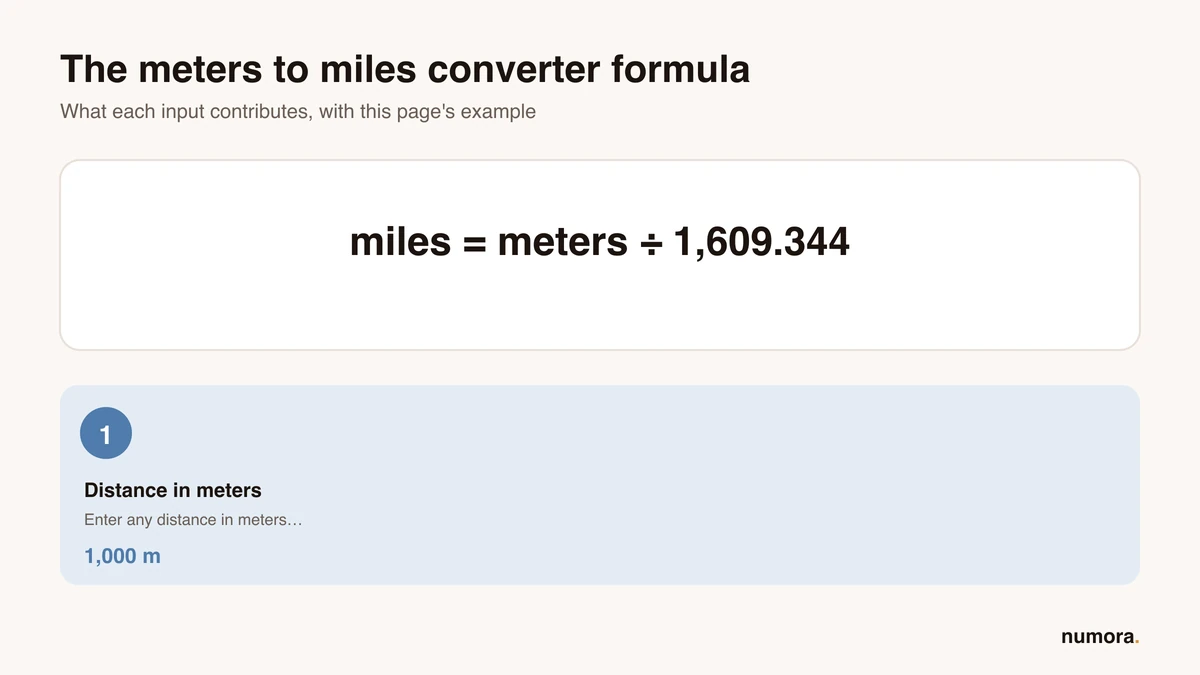
The formula
- miles — distance in international miles (result)
- meters — distance in meters (input)
- 1,609.344 — exact number of meters per international mile, per NIST SP 811 and the 1959 International Yard and Pound Agreement
Source: International mile defined as 1,609.344 meters exactly (1959 International Yard and Pound Agreement; NIST SP 811, Table B.6; BIPM SI Brochure 9th edition, 2019).
Worked examples
1Converting 1,000 meters (1 kilometer) to miles
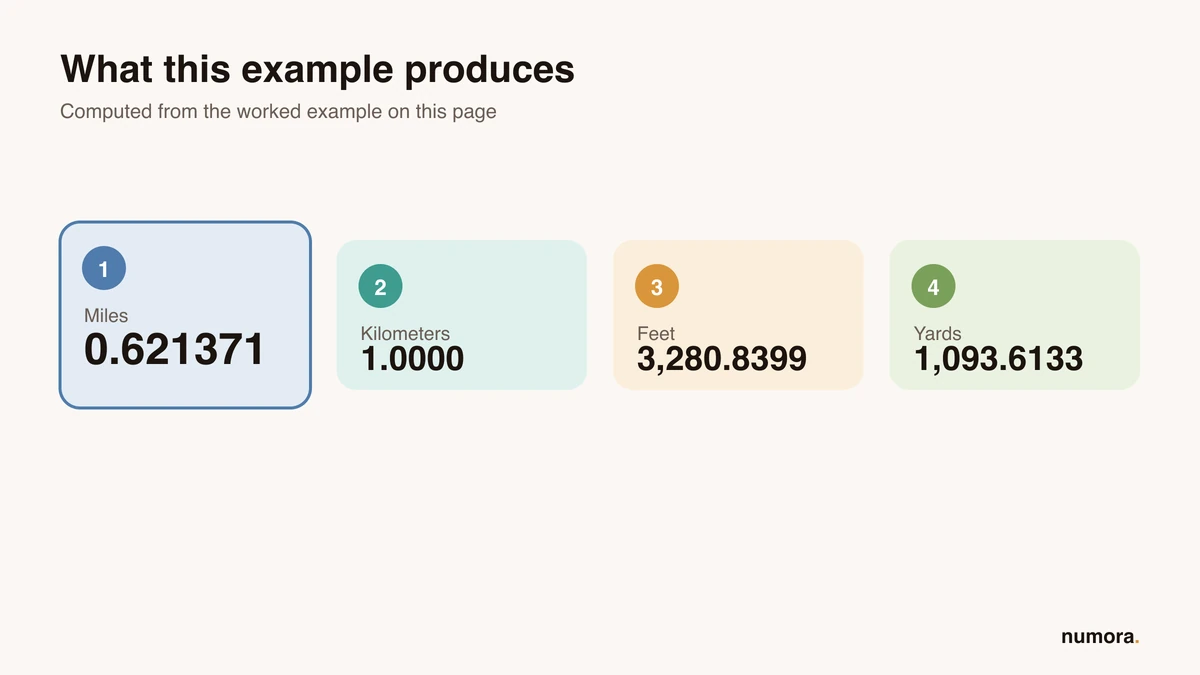
Start with 1,000 meters — one full kilometer. Apply the exact NIST SP 811 factor: divide 1,000 by 1,609.344. The result is 0.621371 miles (to 6 decimal places). This is the well-known benchmark that 1 kilometer equals approximately 0.6214 miles. The full precision value is 0.621371192237334 miles, confirming the rounded figure most runners and travelers use. Because the factor 1,609.344 is exact by international definition, the only source of imprecision is the number of decimal places you choose to display — not the underlying arithmetic.
2Marathon distance: 42,195 meters to miles
The standard marathon is defined as 42,195 meters by World Athletics. Dividing by the exact factor 1,609.344 gives 26.21875 miles — the well-known '26.2 miles' that every runner knows. The precise figure is 26.2187500000 miles, which is itself an exact decimal because 42,195 m was chosen specifically to match 26 miles and 385 yards under the same 1959 international foot definition (1 yard = 0.9144 m exactly). This example confirms the factor produces a clean result at an authoritative real-world distance.
3Verification: 1,609.344 meters should equal exactly 1 mile
Enter 1,609.344 meters — the definition of one international mile. Dividing 1,609.344 by 1,609.344 produces exactly 1.000000 miles. This is the definitional anchor: the International Yard and Pound Agreement of 1959, ratified by the United States, United Kingdom, Australia, Canada, New Zealand, and South Africa, fixed 1 international mile as exactly 1,609.344 meters. NIST SP 811 (Table B.6) and the BIPM SI Brochure (9th ed., 2019) both cite this exact value. Any converter that returns a value other than 1.000000 for this input has a faulty factor.
How to use this calculator
- Distance in meters — Enter any distance in meters — from millimeter-scale values (0.001 m) to marathon distances (42,195 m) or beyond.
- Read the result. Use the worked examples below to sanity-check against a known scenario.
What your result means and what to do next
Common mistakes and edge cases
Using a Rounded Factor Instead of 1,609.344
The most common error is dividing by 1,609, 1,609.3, or 1,609.35 instead of the exact 1,609.344. At one mile the difference is 0.344 m (about 1.1 feet). Over 100 miles that accumulates to 34.4 m — meaningful for route planning, surveying, and competitive athletics timing. The exact factor is not hard to remember: 1,609.344.
Confusing the International Mile with the US Survey Mile
The US survey mile (1,609.3472 m) was used in legacy US land surveys and differs from the international mile by about 3.2 mm per mile. The US survey foot was retired on January 1, 2023. Unless you are working with pre-2023 US geodetic datasets explicitly stated to use the survey foot, always use the international mile (1,609.344 m).
Confusing Miles with Nautical Miles
One nautical mile equals exactly 1,852 meters — not 1,609.344 meters. Nautical miles are used in aviation and maritime navigation. If your source distance is in nautical miles, divide by 1,852 to get kilometers, or multiply by 1.15078 to get international miles. Never use the land-mile factor for nautical-mile inputs.
How small changes affect your result
Because the conversion is linear (miles = meters × constant), every sensitivity scenario is straightforward. The only variable is the input value.
Common distance landmarks: meters vs miles
| Distance | Meters | Miles (exact factor) | Common description |
|---|---|---|---|
| 100 m sprint | 100 | 0.062137 | Olympic sprint |
| 1 city block (US avg.) | 160 | 0.099419 | Approx. 1/10 mile |
| 1 kilometer | 1,000 | 0.621371 | Common road marker |
| 1 mile | 1,609.344 | 1.000000 | Definitional anchor |
| 5K race | 5,000 | 3.106856 | Common road race |
| 10K race | 10,000 | 6.213712 | Common road race |
| Half marathon | 21,097.5 | 13.109375 | 13.1 miles |
| Marathon | 42,195 | 26.218750 | 26.2 miles |
| 50 km ultra | 50,000 | 31.068560 | Ultra distance |
All miles values computed by dividing meters by 1,609.344 (exact). The marathon and half marathon figures are exact decimals because those distances were originally defined in yards.
Frequently asked questions
How many miles is 1 meter?
How many meters are in a mile?
How do I convert meters to miles without a calculator?
Is 1,609 meters equal to 1 mile?
What is a marathon in miles?
What is 5,000 meters in miles?
How many meters is a 10-mile run?
What is the difference between a US survey mile and an international mile?
Meters to Miles glossary
How we built this calculator
Methodology
Every meter-to-mile conversion reduces to a single division: miles = meters ÷ 1,609.344. The factor 1,609.344 is not an approximation — it is an exact, defined value with no uncertainty. It follows from the 1959 International Yard and Pound Agreement, which fixed 1 yard as exactly 0.9144 meters. Because 1 mile = 1,760 yards, multiplying gives 1,760 × 0.9144 = 1,609.344 m/mi exactly.
Sources & references
Every numeric assumption traces to a primary source.
- NIST SP 811 (2008 ed., amended 2019) — Table B.6: Conversion factors for lengthUSA
- BIPM SI Brochure, 9th edition (2019) — The International System of UnitsINT
- Federal Register — Deprecation of the US Survey Foot (effective January 1, 2023)USA
- NIST — International Yard and Pound Agreement (1959)USA
- Numora Editorial Policy. numora.net/editorial-policy